

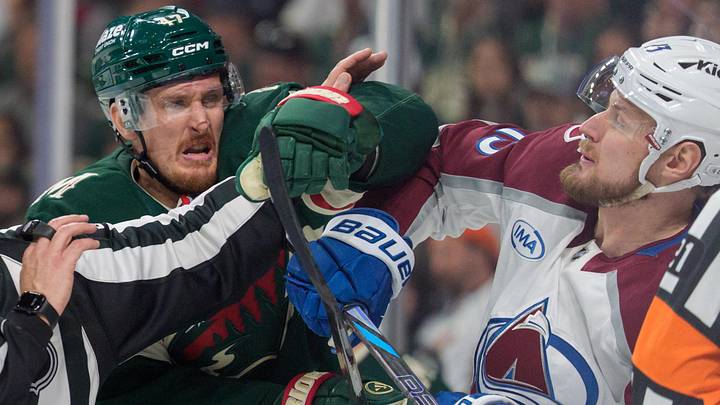
On Tuesday, the Minnesota Wild announced that they had signed free agent forward Michael McCarron to a six-year, $20 million contract. According to Puckpedia, the deal will carry an average annual cap hit of $3.33 million.
McCarron originally came to Minnesota on a trade deadline deal that saw the Wild send a second-round pick in the 2028 NHL Draft to the Nashville Predators in exchange for McCarron. It was a steep price to pay, but the Wild got the best of McCarron during their playoff run; he won draws, killed penalties, and chipped in two goals and two assists in 11 playoff games.
McCarron was undoubtedly effective for the Wild in the playoffs, and the free agent market was notably light on center options. However, McCarron’s deal is another in a growing list of long-term deals for bottom-six forwards. The Wild’s recent track record on those deals is shaky at best.
Wild have a risky history of locking up bottom-six targets
The Wild have made this move before. Back in September of 2023, the Wild signed Marcus Foligno to a four-year, $16 million contract extension. Two years into that deal, Foligno has struggled to live up to the $4 million AAV. Foligno had 29 points (14 goals and 15 assists) with a plus-7 plus/minus rating in 77 games in the 2024-2025 season, but his production dipped last season. He scored only 8 goals and 13 points in 56 games last year. Foligno finished with a 35% goals for percentage last season.
Less than a year later, Minnesota signed free agent Yakov Trenin to a four-year, $14 million contract. Trenin is a similar player to Foligno, and he has also had an up-and-down first two years of his deal with the Wild. Trenin scored seven goals and 15 points in 76 games during the 2024-2025 season. He bounced back slightly last season, scoring 6 goals and 23 points in 82 games. Both players are signed through the 2027-2028 season.
Neither Trenin nor Foligno was signed for their offense, but it’s hard to argue that either has lived up to their contracts so far. According to Puckpedia, the Wild currently have 11 forwards under contract, making $48,789,166 for the 26-27 season. Trenin, Foligno, and now McCarron will make a combined $10.8 million next season. That’s just over 22% of the money spent on forwards locked up in three bottom-six forward options. If that wasn’t enough, McCarron and Foligno are both over 30, and Trenin will turn 30 this January.
The impact on roster construction
Of course, bottom-six forwards are necessary; not everyone is paid to score goals. However, locking yourself into players like McCarron, Foligno, and Trenin long-term limits the Wild's scoring depth. All three of those players are most effective in bottom-six roles, and at their age, there is minimal if any untapped offensive upside to unlock. McCarron did spend some time in a top-six center role in the Colorado series in the playoffs, but that’s not a position you want to be playing McCarron long term.
The McCaron signing and the Foligno and Trenin contracts speak to a larger team philosophy about the bottom six. The Wild clearly prioritize locking up players with experience and physicality for bottom-six roles. Experience, physicality, and penalty-killing ability are all good traits for a bottom-six player. However, when you lock yourself into specific players for those sorts of specific roles long-term, you run the risk of age tanking those players' effectiveness in those roles. It also becomes harder to test out younger, cheaper options in those roles because of the financial commitment made to an experienced player like McCarron. Younger players may introduce more volatility into the lineup, but as Foligno and Trenin have shown, experience doesn’t necessarily ensure consistency.
That said, it’s still only June, and the cap is going up, which means these contracts won’t have as much impact on the salary cap situation in the future. The Wild will now have to hope that the McCaron deal diverges from the underwhelming pattern that the Foligno and Trenin contracts have fallen into so far.
 Add us as a preferred source on Google