

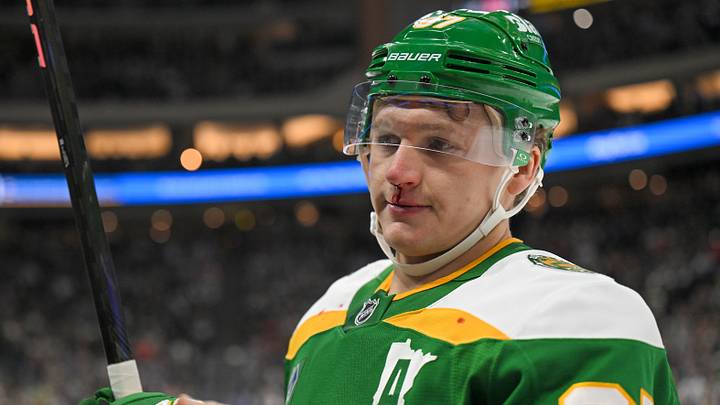
The Minnesota Wild found a way to sign Kirill Kaprizov to a contract extension before the start of last season, but the final cost provided some sticker shock. At $17 million per season, Kaprizov became the highest-paid player in the NHL at the time the eight-year, $136 million contract was signed and the effects have been felt as the Wild have looked to improve the team this offseason.
But another way the Wild’s contract has aged poorly has come as they’re trying to sign fellow star Quinn Hughes to an extension. With a contract that many believe could flirt with a value of $18 million per season, fans are bracing for the final dollar amount that Hughes could command. It may also go even higher as Kaprizov’s deal and other contracts around the league have only driven the price higher as negotiations continue.
“Like it or not, Kaprizov’s $17 million salary created a whole new benchmark in this rising-cap world,” The Athletic’s Michael Russo wrote. “It set the table for the $18 million cap hit attached to Leo Carlsson’s offer sheet [with the Philadelphia Flyers] and the $18.8 million cap hit Macklin Celebrini received in a deal brokered by Hughes’ agent, Pat Brisson. …According to multiple league sources, speaking on the condition of anonymity to address negotiations that aren’t public, that’s his intention [to extend]. But the market turning upside down has made this a lot harder than the Wild anticipated.”
Kirill Kaprizov’s contract is sabotaging the Wild’s negotiations with Quinn Hughes
Hughes was never going to sign a team-friendly contract to stay in Minnesota but the butterfly effect of Kaprizov’s contract began well before he was traded to the Wild last December. Knowing the ball was in his court after owner Craig Leipold stopped short of offering a blank check before he entered the final year of his contract last season, Kaprizov reportedly turned down an eight-year, $128 million contract before signing his official contract last September.
In addition, Sportsnet’s Elliotte Friedman reported that the Philadelphia Flyers would have been willing to throw a similar amount of money at Kaprizov if the Wild star had not re-signed.
Many figured that Kaprizov’s deal was a lot of money but fair considering the NHL’s salary cap was rising over the next three seasons. But similar stars including Connor McDavid ($12.5 million AAV) of the Edmonton Oilers and Jack Eichel ($13.5 million AAV) of the Vegas Golden Knights took less money to build a competitive team around them, creating a large outlier in the market.
This offseason, that gap has been closed. Carlsson signed a five-year, $90 million offer sheet with the Philadelphia Flyers earlier this offseason and officially became the NHL’s highest player at $18 million per season when it was matched by the Anaheim Ducks. Macklin Celebrini took that title a few weeks later, agreeing to a five-year, $94 million contract with the San Jose Sharks that had an AAV of $18.8 million and it could continue to rise with Hughes becoming the next domino to fall.
Quinn Hughes’s next contract could shape the Wild’s championship window
Hughes’s contract presents a few challenges. Leipold mentioned earlier this summer that the Wild are trying to sign him to a five-year deal, but Russo noted that he wants a three-year deal not only to potentially sync his contract with his brother and New Jersey Devils star Jack Hughes, but also cash in after the 2029-30 season at the age of 29.
There’s also the issue of paying two star players big money. The Edmonton Oilers have been able to go to a pair of Stanley Cup Finals while paying McDavid and Leon Draisaitl, but they’ve also had significant holes in their roster that have kept them from hoisting the Cup.
With Colorado Avalanche defenseman Cale Makar also working on an extension, Russo speculated that either player could ask for $20 million per season, which would put them into another stratosphere.
The Wild are in a position to absorb Hughes’s contract right now, but they could face similar holes in their lineup unless some of the bargain signings such as Maxim Shabanov and Bobby Brink pan out. It’s also to note that finding those bargains could also become more difficult as more players sign big deals across the league and could be why the Wild are pushing for a five-year deal as opposed to a three-year.
Guerin has said in the past he would rather overpay than not have that player and there was no way of knowing that Hughes would fall out of the sky when he told the Vancouver Canucks he wasn’t going to extend last December. And for someone that’s on a Hall of Fame trajectory entering his prime, few will complain if Hughes signs an extension. But it’s a process that has become complicated thanks to Kaprizov’s pay day one year ago and may only get worse if the Wild break the bank to keep Hughes in Minnesota.
 Add us as a preferred source on Google