

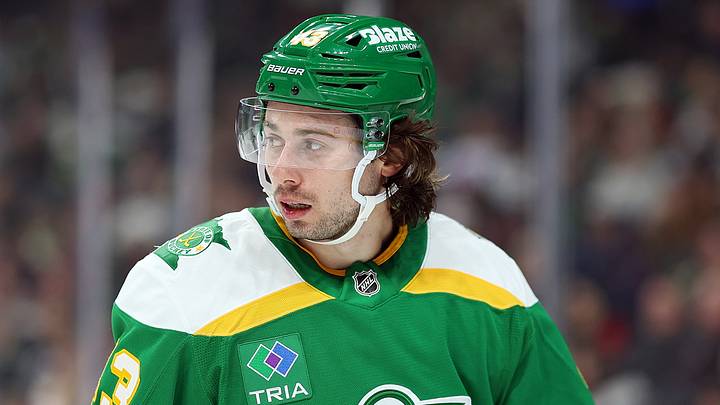
The Minnesota Wild and Quinn Hughes are approaching a crossroads in their negotiations on a contract extension. While the negotiations have been centered around what Hughes wants and how soon he wants to play with his brothers, it may also center around an important date of Sept. 15.
The Athletic’s Michael Russo and Joe Smith pointed out on Tuesday morning that Sept. 15 is the last day that Hughes can sign an eight-year contract extension with the Wild under the league’s current collective bargaining agreement. When the new CBA kicks in the following day, the maximum term the Wild could offer on an extension goes down to seven years as a player that would be re-signing with his current team.
Term has been one of the holdups as Hughes ponders signing an extension in Minnesota. But with his negotiations coming down to the wire and the start of the regular season approaching, the possibility of signing him to a blockbuster deal is running out and could be something that costs the Wild in the long run.
Wild have a very good reason to sign Quinn Hughes to a long-term deal
The Wild knew what they were getting into when they traded for Hughes last December. While Hughes did not guarantee he would sign a contract extension with his new team after the Vancouver Canucks placed him on the trade block, it didn’t stop general manager Bill Guerin to offer Marco Rossi, Zeev Buium, Liam Ohgren and their 2026 first-round pick (Adam Novotny) to get the deal done.
Minnesota reaped the benefits in the short term as Hughes scored five goals and recorded 53 points in 48 regular season games and helped the Wild win their first playoff series since 2015, scoring four goals and recording 15 points during their 11-game run. But that performance along with the rising cost for elite players have made his negotiations difficult.
The Wild contributed to this problem by signing Kirill Kaprizov to an eight-year, $136 million contract ($17 million AAV) last fall, but the problem could have been avoided with a longer term in his previous deal according to The Athletic’s report.
“Remember, one of the holdups in the 2021 Kaprizov negotiations was he wanted eight years at more than $9 million per year, and the Wild didn’t want to go beyond five years for a player who had only 55 games of NHL experience, all during the pandemic-shortened season. And not going eight years turned out to be costly for Minnesota.”
Had the Wild been able to sign Kaprizov to an eight-year deal worth between $9 and $10 million, they’d still have him under team control through the 2028-29 season. It also would have come at a similar bargain to the one Minnesota is currently enjoying with Matt Boldy ($7 million AAV) and Brock Faber ($8.5 million).
Knowing that gaffe cost the Wild $8 million in cap space, the report also says the Wild could look at a long-term deal for Hughes worth $20.5 million per season, which could look much different at the end of the deal than it does now. It also gives Hughes $164 million in guaranteed money and the chance to exceed Cale Makar’s eight-year, $163.2 million extension with the Colorado Avalanche, which would be difficult to turn down.
Even if Hughes reversed course during the contract due to his desire to play with Jack Hughes and Luke Hughes on the New Jersey Devils, that trade could be arranged later in the deal. But that could only happen if the Wild lock him into a long-term deal before next week.
Wild’s time to reach a blockbuster deal with Quinn Hughes is running out
It should be made clear that Sept. 15 is not a final deadline for a contract. It has been long speculated that Hughes would prefer a three-year deal to sync up with Jack Hughes’s current contract that expires at the end of the 2029-30 season. If that’s what he prefers, the Wild could offer a three-year, $60 million contract that gives Hughes the option to play with his brothers and maximize his earning potential a few years down the road.
But that also shortens the Wild’s championship window to four seasons and creates an unlikely scenario to retain Hughes past his next contract. While Boldy and Faber are cheap now their salaries could be closer to what Kaprizov is making and what Hughes could make in his next deal by the time their contracts expire. This makes locking Hughes in for as long as possible an important piece of the puzzle and allows Guerin to budget for the next wave of extensions accordingly.
Like everything in this negotiation, it could center around what Hughes wants. If he’s unwilling to budge on term, the Wild would be wise to agree to three years and figure out the rest later. If he’s willing to go eight years, Minnesota could get a massive win, but it shouldn’t be the deciding factor whether a deal gets done.
While everything has been clouded in mystery, Sept. 15 is a date that can decide an important factor in negotiations and could have Hughes one step closer to a decision.
 Add us as a preferred source on Google