

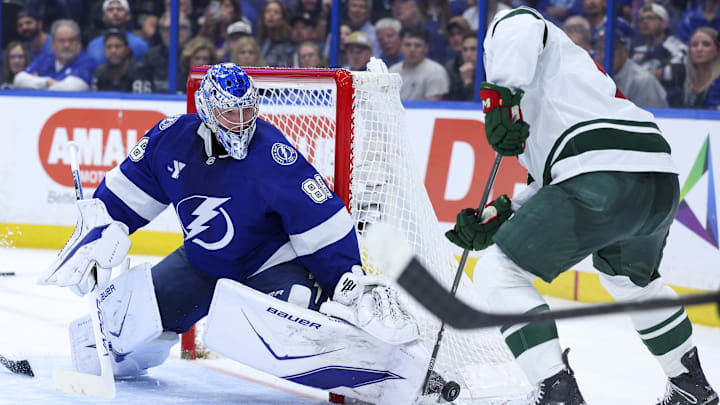
With the aid of two power-play goals and the return of Kirill Kaprizov and Joel Eriksson Ek, the Minnesota Wild built a 3-1 lead midway through their game against the Tampa Bay Lightning on Tuesday night. The two-time Stanley Cup champions rallied back to tie the game with a power play goal of their own compliments of soon-to-be extremely rich defenseman Darren Raddysh, but the Wild responded. With seconds to go in the period, Michael McCarron converted a rebound that seemed to give the road team a 4-3 lead.
But wait….
The Lightning waved the officials over to their bench for a discussion, and decided to challenge for goaltender interference. In their estimation, Andrei Vasilevskiy was denied the ability to make a save after Darren Raddysh was pushed into him by Bobby Brink. Vasilevskiy made an initial save on Brink’s first attempt, but was unable to stop McCarron’s follow-up shot as he was tangled up with his own defenseman.
Michael McCarron. 4-3 #mnwild pic.twitter.com/VOmr2OSeJv
— Spoked Z (@SpokedZ) March 25, 2026
As the officials on the ice and in Toronto reviewed the footage, the TNT television crew had their own debate about whether the goal should stand. Eddie Olcyk in particular was of the opinion that the goal shouldn’t count, but mentioned that in previous cases the challenges had been denied.
They were somewhat shocked when the officials announced that the goal would indeed be overturned and the score would remain tied at three. The Lightning would take advantage of a lucky bounce on a puck that flummoxed Filiip Gustavsson in the third period and then add two empty-net goals to win by a 6-3 margin.
The Rule
By definition, the officials got the call right. Rule 69.1 states that,
“If a defending player has been pushed, shoved, or fouled by an attacking player so as to cause the defending player to come into contact with his own goalkeeper, such contact shall be deemed contact initiated by the attacking player for purposes of this rule, and if necessary a penalty assessed to the attacking player and if a goal is scored it would be disallowed.”
As replays show, Brink definitely pushed Raddysh into Vasilevskiy. Therefore, the goal should have been disallowed.
The Reaction
Following the game, both Brink and McCarron were asked about the play. Their reactions were pretty much the same.
McCarron:
“Yeah, I thought their guy dove right into their goalie honestly. Brinksy’s not that big of a guy. The guy he pushed was 6’8”. Unfortunate. I haven’t seen a replay. I don’t want to say the refs made a right or wrong call, but I did see Brinksy push down a six-eight guy like he was a five-four player.”
For the record, Darren Raddysh is 6’1”.
Brink:
“I mean, I cross-check him and he falls into the goalie, but I think he goes down pretty easy. If you watch the replay you can see some stuff. But, I’ll let everyone else make their own decisions on that. I don’t blame whoever made it as a bad call or anything, it’s just their choice and that’s what they went with.”
Give Brink credit, he’s fitting in well and returning to his Minnesota Nice roots with those slightly passive-aggressive comments (also, never admit to the crime!).
McCarron did mention that it was a huge momentum swing in the game and if the goal stood, it’s a different finish to the contest. Tampa Bay had the better run of play in the third period leading up to the Cernak goal, but who knows how they would have had to play if they were trailing instead of tied.
 Add us as a preferred source on Google