

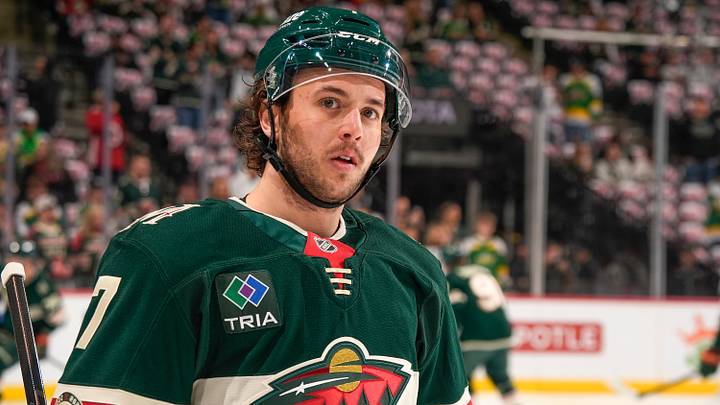
The Minnesota Wild could welcome back Brock Faber to the lineup against the Boston Bruins on Saturday night as he missed the past seven weeks with a fractured skull. Faber’s return is a morale boost for the Wild, who did their best to navigate other injuries on the blue line. But it also could give them a boost in the team’s scoring.
Faber scored 15 goals and recorded 51 points in 80 games for the Wild and added four goals and 10 points during their 11-game playoff run last season. The offensive output went into another gear when Quinn Hughes made his debut for Minnesota on Dec. 14, scoring nine goals with 36 points over his final 48 games.
Those numbers are one reason why fans will be excited to welcome Faber back. But it’s also why it could lighten the load on a team dependent on its top line for offense.
Brock Faber’s can help the Minnesota Wild become less dependent on their top line for goals
The Wild have done a good job while Faber has been out, posting a 13-3-4 record and leading the Central Division with 30 points entering Thursday. That start has been even more impressive considering most of their start has been on the road and the Wild rank 14th with 3.25 goals per game.
To achieve that start, the Wild had to play more of a defensive game, which has been aided by Jesper Wallstedt’s breakout as the team’s No. 1 goaltender. But the offense has also come from Hynes’s decision to put Kirill Kaprizov, Matt Boldy and Joel Eriksson Ek on the top line.
The top line has scored 30 of the Wild’s 65 goals this season and if you add Hughes, who has been on the Wild’s top defensive pairing, that’s 36 of Minnesota’s 65 goals, representing 55.3 percent of their scoring output.
While Maxim Shabanov (eight goals) and Danila Yurov have contributed to the cause, the Wild have had trouble finding offense anywhere else as Bobby Brink hasn’t found a scoring touch, Marcus Foligno and Nick Foligno have been out with injuries and Ryan Hartman looks lost amid a contract year and trade rumors.
A trade for Dylan Larkin may be one way to help the cause. But that doesn’t seem imminent, as the Detroit Red Wings hold out for the best offer possible. Until that or another deal goes down, the Wild have to figure it out, and getting Faber back is a key piece of the puzzle.
Brock Faber’s return could help the Wild fix their biggest offensive weakness
The most obvious impact that Faber will have is on the blue line. Hughes has held his own with six goals and 27 points in his first 20 games of the season, but he could also be allowed to take more offensive risks with Faber playing next to him.
Faber could also benefit from a top line that’s playing out of its mind right now, generating more chances not only for himself, but for his teammates to make them an even more potent combination. While Faber will certainly play with Kaprizov, Boldy, Eriksson Ek and Hughes, there’s also the benefit of him playing with different groups of forwards.
Last season, Faber was second on the team with an average of 24:41 of ice time per game. That number also jumped to 29:44 during the playoffs, which means that he’ll be out there making plays no matter what group of forwards is on the ice.
By comparison, Hughes leads the Wild with 28:11 of average ice time entering Thursday, and the next closest player is Jonas Brodin, who’s 22:34 of ice time is just ahead of Kaprizov (21:29) and Boldy (21:27).
If Faber continues the offensive breakout he showed toward the end of last season, it may not take him long to start driving some offense. If that helps the top line, it should also help the other three lines and help Minnesota put more pucks in the back of the net to complement their fast start.
 Add us as a preferred source on Google