

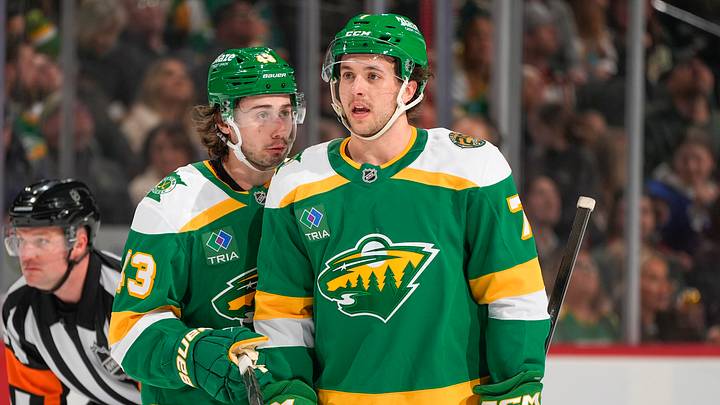
As the Minnesota Wild hit the ice for training camp on Thursday, the biggest story revolves around Quinn Hughes. Hughes transformed the Wild into Stanley Cup contenders a year ago, but while he’s under contract for this season, he’s set to become a free agent next summer. Understandably, the Wild have been working to sign Hughes to a contract extension, but Hughes has been non-commital, evaluating the situation and taking his time before signing on the dotted line.
Hughes said during the NHL’s Player Media Tour last week that the Wild have a lot to offer and signing a short-term extension (such as a rumored three-year deal) could emphatically open Minnesota’s championship window. But the biggest selling point might be the chemistry he’s established with Brock Faber and how the two could take another leap this season.
“I feel excited to play [and] excited to play with Brock again,” Hughes said during an interview on the 32 Thoughts podcast with Elliotte Friedman and Kyle Bukauskas. “...I’m excited to…continue building with those guys and start from scratch instead of starting from Game 40 or whatever it was.”
Quinn Hughes helped Brock Faber take off in Minnesota
Hughes’s arrival to Minnesota bolstered the Wild in a lot of ways, but the biggest was unlocking another level in Faber’s game. Faber was always considered a fixture on Minnesota’s blue line and there’s a good chance he’ll become the team’s captain once Jared Spurgeon moves on. But Faber’s 2025-26 season began on a low note with no points and a minus-5 rating in his first nine games and six goals, 15 points and a plus-2 rating in his first 32 games.
When the Wild traded for Hughes, Faber took off. The biggest change was that Faber showed more aggressiveness on the offensive end, scoring nine goals and 36 points over 48 regular-season games with Hughes. That trend hit another gear in the playoffs as Faber scored four times, recorded 10 points and a plus-11 rating in 11 games.
But the benefit of working with Hughes extended beyond stats. Faber found more space due to the attention that Hughes commands and his partner’s ability to enter the zone and create breakouts with his passing helped take pressure off of him and allowed him to do more on the ice.
“I think he opened my eyes completely,” Faber said during an interview on the Wild and 7th podcast last April. “I’ve learned so much from him since he’s gotten here. Just about little things. …It feels like there’s so many things he does that are so little risk but high reward. …I feel like I’m just getting more and more confidence with the puck on my stick, wanting it on my stick and being confident that I can catch a guy on the way back if something bad happens. It’s crazy how much I’ve learned from him since he got here.”
Remember, this wasn’t over the course of a full season. This was the effect of the pairing playing in 59 games between the regular season and the playoffs. The idea of a Hughes and Faber pairing coming into this season is exciting because there feels like there’s room to grow and it gives Hughes even more to think about as he considers signing an extension.
Brock Faber may be the perfect partner for Quinn Hughes going forward
The deadline for signing an eight-year deal has passed as the NHL’s new collective bargaining agreement kicked in this week. It’s also unlikely that Hughes would sign a maximum seven-year deal allowed by the new CBA as it’s been rumored that he would prefer to sync his contract up with his brother, Jack Hughes, whose contract with the New Jersey Devils after the 2029-30 season.
But even if Hughes wants to expedite the process and head to New Jersey next summer, his partnership with Faber should make him think twice. Hughes will turn 27 on Oct. 14 while Faber turned 24 last summer. Having a defensive partner who is also in his prime is one way to maximize his value for his next contract and it would give Hughes at least three shots at a Cup, assuming he signs a three-year extension.
That’s something the Devils couldn’t provide as Jonas Siegenthaler, Dougie Hamilton, Brett Pesce, and Brenden Dillion will all be over the age of 35 next season. While Devils fans have tried to manifest their Hughes family reunion, Quinn and his other brother, Luke Hughes, both play on the left side, meaning they would need to play on defensive pairings.
Unless top prospect Seamus Casey has a quick onboarding to the NHL, it wouldn’t be close to what Hughes currently has with Faber. Plus, it would take time to get used to his new surroundings. While it didn’t take long for Hughes to figure it out in Minnesota, it may have been bolstered by a blue-chip talent like Faber, resulting in a significant downgrade if he headed east or most of the other destinations.
Hughes knows this, which may have been why he noted the Wild had nothing to prove as he considers an extension. But if Hughes needs an extra little nudge, it could be his partnership with Faber and how far it could take the Wild in the coming years.
 Add us as a preferred source on Google